Showing posts with label Loose Sapphire. Show all posts

Monday, September 23, 2013

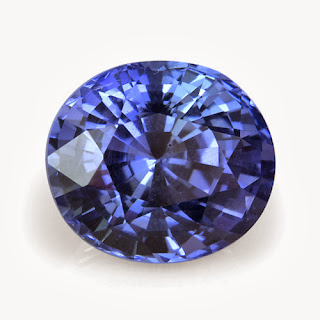
How do sapphires get their color?


Cornflower blue sapphire, Ceylon Sapphire, Blue Sapphire
I had a few customers enquiring about sapphire colors and the difference between ruby and sapphire. Well, I do not intend to be too technical here, but it is exciting to know a little more about these beautiful natural sapphires. I’ll try to be as clear and concise as possible. 

Firstly, sapphire and ruby both belong to the the family of corundum, which comes in all colors. All colors except red are referred to as sapphire.

Corundum in its purest state is aluminum oxide (Al2O3), which is a colorless sapphire. Additional elements or impurities combined with these base elements gives the breathtaking sapphire colors. 

Combination of titanium and iron makes a blue sapphire. Chromium impurities make a ruby red - various shades of pink to red are based on the amount of chromium. Existence of chromium with other elements of a blue sapphire makes a purple sapphire. Yellow sapphires are a bit more complicated. They have a few different ways of getting their color. Majority are colored by the existence of iron (I won’t discuss other methods here as it involves a lot more chemistry). Iron is also responsible for green sapphires; due to rarity green sapphires are virtually unheard of. 

As you can see iron is responsible for blue, yellow and green colors. Majority of Australian blue sapphires tend to have more of a greenish secondary hue mainly due to higher quantities of iron. 

Other than the color, all other properties such as hardness and toughness remains the same across all sapphire colors. 

We are also working on updating the website with a more descriptive content around sapphire colors. Until then hope you enjoy reading. 


Thursday, July 4, 2013

Time for transparency?


Recently I had a discussion with a gemmologist who is also a gem supplier and predominantly supplies heat treated sapphires to the Australian market. I’ll try not give you clues of who this person is. 

He/ She says that when he/ she sells a heat treated sapphire to a customer he/ she does not disclose that the stone has been heated unless the customer enquires. His/ Her argument is that as no external elements have been added in the process of heat treatment, the stone is 100% natural and that they have simply sped up the heating process that would have otherwise occurred naturally under the Earth’s surface. He/ She proceeds to say that Australian customers do not tend to query whether the sapphire has been treated, but international customers such as in Europe and US do query this often. 

I believe this has more to do with lack of customer awareness here in Australia, whereas European and US customers are a lot more educated about gemstone enhancements. 

I feel this is a bias opinion from a seller who supplies heated sapphires. Whilst I appreciate that heat treatment has assisted vastly to maintain reasonable prices by increasing sapphire supply in the market, it is still an enhancement to the natural stone. There is no guarantee that a heated sapphire would have the same performance if it was left underground for many thousand years more. One of the greatest fascination of gemstones is their rarity. Evidently fine quality unheated sapphires are rarer than enhanced sapphires. 

Image courtesy of Stuart Miles / FreeDigitalPhotos.net
Customers need to be aware of what they are purchasing. 
In my opinion, if the seller is aware of any kind of enhancement to the gemstone it should be disclosed regardless. The customer can then proceed to ask more questions. This would be a great opportunity for the seller to educate the customer about the difference between traditional heat treatment and other treatment methods. 

We used to deal with heated sapphires ourselves, but we disclosed all information we were aware of. I think it is important to disclose known enhancements of a gemstone and educate customers in order to maintain a trustworthy industry. 

This is such a dividing topic, your opinion is greatly appreciated. 


Thursday, May 30, 2013

How it becomes an eye catching sparkle


This time I visited the lapidary in Sri Lanka I remembered to take some photographs. In fact, I took a video tape but it appears to be corrupted. I will try to have this fixed.  So, here is how a rough crystal is turned in to a beautiful sparkly gemstone.


Step 1 - Preforming the gemstone crystal - At this step cutter decides what shape the gemstone will be cut. Pictured is a cutter preforming a natural garnet. He is holding the stone by hand against the wheel. The wheel is spinning in water to avoid heat build up. You can also see some garnet crystals on the table.


Step 2 - Faceting a preformed gem - Once the stone has been preformed to its shape, cutter then facet the gemstone. In above picture, a cutter is faceting a natural sapphire. Fine diamond dust has been rubbed on the spinning plate. Water drips on to the plate to avoid heat build up.


Step 3 - Polishing the faceted gemstone - Last but not least the faceted gemstone is polished to obtain the beautiful lustre. Pictured is a cutter polishing a pink sapphire. Sapphires are polished on a copper plate with extremely fine diamond dust.

And.....here comes the beautifully faceted gemstone!


I hope you find this process is as fascinating as I think it is.


Sunday, May 26, 2013

Second largest gemstone market in Sri Lanka


Two weeks ago I suddenly decided to visit Sri Lanka to surprise my friend at her wedding and to meet my first niece for the first time. Initially I thought that I will have to miss the wedding due to other commitments here in Melbourne and that I will visit to see my niece a little later, but as the wedding approached it broke my heart not to be there at my best friend’s wedding. So I flew! 

During this short visit I managed to visit the second largest gemstone market in Sri Lanka. Its in Beruwala close to my home town. This time I took a brief video clip so you can see what it is like over there. To protect the privacy of the buyers and sellers I wasn’t comfortable in recording a longer clip, but I hope this short clip will give you an idea. This visit to the market wasn’t intended for us to purchase gemstones, but to give you an insight to the gemstone market culture in Sri Lanka.


As you will see all merchants and buyers just deal on the street. Market has sections such as Indian quality (low quality stones), rough sapphires, cut and polished sapphires, semi-precious gemstones and so on. 


Sapphire, Loose Sapphire, Gem Market, gem Market Sri Lanka
A seller showing us a parcel of loose sapphires
As soon as we arrived at the market sellers started showing us gemstones they have. Now that we were there, our guide took us to his office on the roadside to look at stones more closely. This market not only has Ceylon sapphires but also Madagascan sapphires. If you appear to have a good understanding of the trade sellers are honest enough to say where the stone comes from. Within an hour or so we looked at over 2,000 gemstones including sapphire, chrysoberyl, spinel, star sapphire and garnet. Most of the stones at the market are treated or low quality stones. They are low clarity, but mostly badly cut in order to retain carat weight. Some sellers prepare sapphire parcels up to 1000 carats and try to sell it at a low per carat price. These parcels may have treated, unheated and even synthetic and glass stones. The truth is you will only find less than handful of quality stones within these parcels and sometimes not even, so its a huge gamble. Indian buyers take the advantage of these parcels as in India there is a huge market even for low quality sapphires. Most of the yellow sapphires and low quality sapphires are bought by Indian buyers. I have to say that some of the most expensive sapphires are also bought buy Indian buyers.

Even after looking at over 2,000 gemstones we only came across less than hundred unheated natural sapphires. Out of these I only shortlisted less than ten natural sapphires and ended up buying only two small sapphires. This clearly shows the rarity of finest unheated natural sapphireAfter looking at this many gemstones within an hour or so I had a severe headache, which was tiring me out. As you get tired sellers show you more an more stones hoping that you will just buy them without inspecting them closely. Hunting for stones at the market really isn’t an easy job. 

Multi million dollar gemstones change hands here. A lot of the transactions are settled based on trust, but it is very easy even for an experienced buyer to get caught in a fraudulent transaction. You have to be very careful if purchasing a stone here. None are certified. You will find all sorts of stones including synthetic and even glass. 


As you can see this gemstone market is highly male dominated. In fact, apart from myself I didn’t see any ladies at the market that day!